
Monday-Saturday:
Buying industrial equipment is never a small decision. It costs money, it takes time to install, and once it is running in your plant, you expect it to last for years without giving trouble. This is exactly why choosing the right mixing tank with an agitator matters so much. Get it right, and your production runs smoothly for a long time. Get it wrong, and you end up spending more on repairs, downtime, and replacements than you originally saved.
In this blog, we will walk through the practical things you should check before buying a mixing tank with an agitator. No heavy technical jargon, just simple points that actually help you make a smart decision.
Why the Right Tank Matters More Than People Think

A lot of buyers treat mixing tanks as a basic, one-size-fits-all product. That is a mistake. Every industry has different liquids, different viscosities, and different mixing needs. A tank that works perfectly for a paint manufacturing unit may not work at all for a food processing plant or a chemical facility.
The mixing tank with the agitator you choose needs to match your exact process. This includes the type of material you are mixing, the speed at which it needs to blend, the temperature involved, and how often the tank will be used. Skipping this step and going for a generic tank often leads to poor mixing quality, wasted raw material, and frequent maintenance issues.
Key Considerations Before You Buy
1. Tank Capacity and Size
Before anything else, think about how much material you actually need to mix at one time. Buying a tank that is too small means you will need multiple batches, which slows down production. Buying one that is too large wastes space and money.
Look at your daily or weekly production requirement and choose a mixing tank with an agitator that fits comfortably within that range, with a little extra capacity for future growth. Most businesses expand over time, so leaving some room for scaling up is always a smart move.
2. Type of Material Being Mixed
Not all liquids behave the same way. Some are thin and mix easily. Others are thick, sticky, or have particles that settle quickly. The agitator design needs to match this behavior.
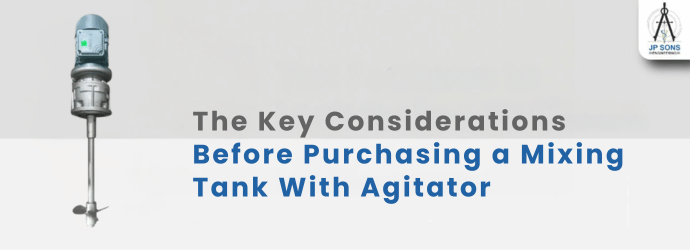
For thin liquids, a simple propeller type agitator usually works well. For thicker or more complex mixtures, you may need a stronger, slower moving agitator that can handle resistance without straining the motor. Talking to your supplier about the exact material you plan to mix helps them recommend the right agitator design for your mixing tank with agitator setup.
3. Tank Material and Build Quality
The tank material plays a big role in how long your equipment lasts. Stainless steel is one of the most common choices because it resists rust, handles a wide range of chemicals, and is easy to clean. This makes it a popular option across food, pharma, and chemical industries.
However, depending on your budget and the nature of the material being mixed, mild steel with proper coating can also work for certain applications. Always ask about the grade of steel used, the thickness of the tank walls, and whether the welding and finishing meet proper industry standards. A well built mixing tank with agitator should feel sturdy, not flimsy or lightweight.
4. Motor Power and Agitator Speed
The motor is the heart of any agitator system. If the motor is underpowered, it will struggle with thicker liquids and burn out faster. If it is overpowered for your needs, you end up paying more for electricity without any real benefit.
Ask your supplier to explain the motor rating and how it matches your specific mixing needs. Also check if the agitator speed is adjustable. Having control over speed is useful because different stages of mixing, like blending, dissolving, or homogenizing, often need different speeds.
5. Design of the Agitator Blades
The blade design directly affects mixing efficiency. Flat blades, curved blades, and turbine style blades all serve different purposes depending on the liquid's thickness and mixing goal.
If your process involves gentle blending, simple flat blades may be enough. If you need strong turbulence to dissolve solids quickly, a turbine style blade may work better. This is a detail many buyers overlook, but it makes a real difference in mixing speed and quality once your mixing tank with agitator is installed and running.
6. Ease of Cleaning and Maintenance
Especially in food, pharma, and chemical industries, hygiene and cleaning matter a lot. Some tanks are designed with smooth internal surfaces and minimal corners, making them much easier to clean between batches.
Ask about access points, whether the agitator can be removed easily for servicing, and how often maintenance is typically required. A tank that is hard to clean or repair will eventually slow down your production, no matter how good it looked on paper during purchase.
7. Safety Features
Industrial equipment should never compromise on safety. Check if the mixing tank with agitator comes with proper guards around moving parts, emergency stop functions, and overload protection for the motor.
These features protect your workers and also prevent costly accidental damage to the machine itself. A slightly higher upfront cost for better safety features is always worth it in the long run.
8. Supplier Reputation and After Sales Support

Even the best tank can run into issues over time. This is why choosing a reliable supplier matters just as much as choosing the right tank. Check how long the company has been in business, read reviews from other buyers, and ask about warranty terms.
Good after sales support means faster repairs, easier access to spare parts, and less downtime if something goes wrong. Before finalizing your mixing tank with agitator, take time to research the supplier's track record, not just the price they quote.
Common Mistakes to Avoid
Many first time buyers focus only on price and end up regretting it later. Here are a few common mistakes worth avoiding.
Choosing the cheapest option without checking build quality often leads to frequent breakdowns. Ignoring the specific properties of the material being mixed can result in poor mixing performance. Skipping questions about motor power and speed control can leave you with equipment that struggles under real working conditions. And forgetting to check safety features can put your workers at risk.
Taking a little extra time to research and ask the right questions before buying can save you a lot of trouble down the line.
About JP Sons Engineering
When it comes to choosing a trustworthy supplier, JP Sons Engineering is a name worth knowing. The company has built a solid reputation for manufacturing industrial tanks and process equipment that are designed to handle real world working conditions, not just look good in a catalog.
JP Sons Engineering focuses on quality at every stage, from selecting the right grade of steel to finishing and testing each unit before it leaves the factory. Their team understands that every industry has different mixing needs, whether it is chemicals, pharmaceuticals, food processing, or paints, and they work closely with buyers to recommend the right specifications instead of pushing a one-size-fits-all product.
What makes JP Sons Engineering stand out is their attention to detail on the things that matter most. Proper motor sizing, durable agitator blades, safe design, and easy maintenance are built into their equipment from the start. They also offer support after the sale, which means fewer worries if you ever need servicing, spare parts, or guidance on getting the most out of your setup.
If you are looking for a mixing tank with agitator that is built to last and backed by a team that actually understands industrial mixing, JP Sons Engineering is a reliable place to start your search. You can explore their range of products and get in touch with their team directly through their website.
Your Next Step
A mixing tank with an agitator is not just another piece of equipment. It plays a direct role in your production quality, efficiency, and consistency. Taking the time to understand capacity needs, material compatibility, motor power, blade design, and supplier reliability helps you make a purchase you will not regret.
Do not rush this decision. Ask detailed questions, compare a few suppliers, and choose equipment that truly fits your process rather than something that just looks good on a brochure. A well chosen mixing tank with agitator will serve your business reliably for years, saving you both time and money in the long run.
If you are exploring reliable options, JP Sons offers a range of agitator tanks built to suit different industrial mixing needs. It is always worth reaching out to discuss your exact requirements before making a final decision.
We design and manufacture complete systems for syrup manufacturing plant and sugar syrup manufacturing plants, ensuring high efficiency and quality output. Our liquid syrup manufacturing plant solutions are equipped with modern industrial homogenizer mixer, heavy-duty storage tanks, reliable industrial water treatment systems, and effective bag filter housing to maintain production standards.
Latest Blog
.png)
Call Us or Fill the Form
We are a top-tier engineering manufacturer that offers our clients the best goods, services, and solutions available.
-
Toll Free Number
+9173593 52645 -
Send us an e-mail.
[email protected] -
Working Hours
Mon - Sat: 9AM - 6PM